The Experiment: Building Content with the Thing That Might Replace Me
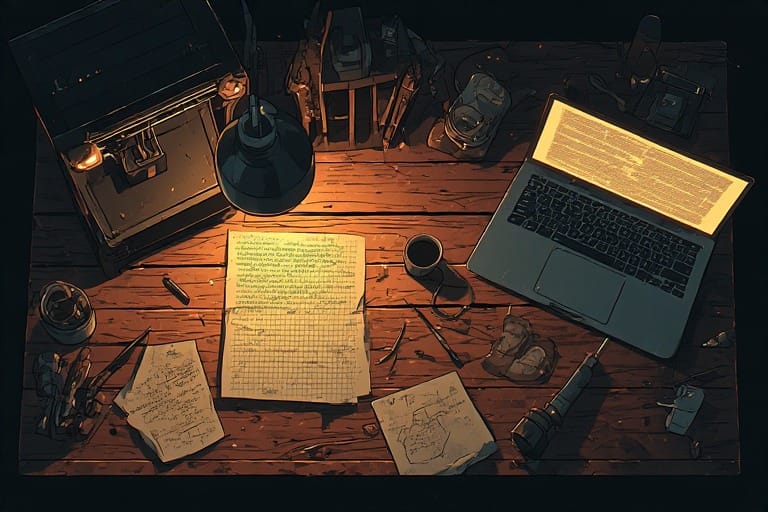
While writing this, I couldn't help but think if this effort is akin to the forever story in online cooking recipes - Get to the point already. That is, in part, why human centric formatting is so important, not just a click farm or pop-up auto playing ad video that plagues so much of today's dead internet content. How do I meaningfully organize content in a way that benefits me and the reader? Will I have ads and advertising? Yes - but I hope it is as thoughtfully placed as the content here is useful.
I Could Probably Do That started as a phrase I kept saying out loud — usually while looking at a product price tag, a contractor quote, or a subscription fee. It's the itch that precedes a rabbit hole. Could I build that shelf? Roast my own coffee? Set up my own water filtration system instead of paying someone?
The site you're reading exists to answer that question. Not with hype, not with a guaranteed "yes you can!" — but with a real breakdown of what it costs, what you learn, and whether the juice is worth the squeeze. And if you can't, is it I can't at all or I can't yet. The critical aspect of learning new things is that you never learn how to do it without attempting the thing itself. Failure is experience for contemplation.
But here's what makes this different from many other DIY blogs: I'm building this entire platform with AI as a primary collaborator, and I'm going to be honest about that from the start.
The Framework
Every project on this site gets evaluated on a simple question: Should you do it yourself, or buy the solution?
That sounds obvious. Everyone asks it. But many people answer it with vibes. They either romanticize the DIY path ("it's so rewarding!") or dismiss it ("your time is worth more than that"). Both can be useful perspectives but often lack the nuance needed for helping others to make a decision.
I break it down with actual criteria — cost comparison, time investment, skill requirements, tool costs, quality of the end result, the knowledge you gain, and whether that knowledge compounds into future projects. Sometimes the math says build. Sometimes it says buy. Sometimes it says build, but not the way you think.
The honest version of this framework also includes the things nobody talks about: the cost of your mistakes, the opportunity cost of the hours you spend, and whether you're doing this because it makes sense or because you're avoiding something else. I've been guilty of all three.
The AI Part
Here's the thing I could either hide or lean into. I'm leaning in.
I use Claude — Anthropic's AI — extensively. Not as a gimmick. As an actual force multiplier for how I think, research, plan, and create. This site's content pipeline works like this:
- I pick the project. The idea, the question, the "I could probably do that" moment — that's mine. It comes from real life. My water tastes weird. My kid needs a reading curriculum. I'm staring at a $200 product I think I can make for $40.
- I research with AI. Claude helps me pull apart technical specs, compare products, find studies, calculate costs, and pressure-test my assumptions. This isn't "AI wrote an article." It's closer to having a research partner who never sleeps and has read more spec sheets than any human should.
- I build (or buy) the thing. This is the part AI can't do. I'm the one with the drill, the 3D printer, the soldering iron, or the credit card. The real-world test is mine.
- I write it up, AI helps me edit. The voice is mine. The experience is mine. The conclusions are mine. But I'm not going to pretend I hand-wrote every sentence from scratch when I have a tool that helps me organize my thoughts faster.
I don't do this in a vacuum either, I have conversations with people and do additional research outside of Claude. I usually bring that back in to align it with everything else or realign the research in Claude with the new thing as an anchor point.
That's the workflow. You can decide how you feel about it. I'd rather you know upfront than find out later and feel misled.
Why I'm Calling This an Experiment
I'm testing several things at once:
Can a single person with a full-time job, a kid, and approximately zero free time build a content platform that's actually useful? For me, the old answer was no — not without a help, not without quitting your job, not without venture capital or at least a trust fund. AI changes that calculus. Maybe. That's what I'm testing.
Can AI-assisted content be genuinely valuable, or does it all converge on the same generic SEO paste? I think the answer depends entirely on whether a real human with real experience is steering it. An AI writing about water filtration without someone who's actually tasted the metallic tap water in my municipal water supply and tested the results is just noise. But an AI helping that person organize and communicate what they learned? That might be something.
Is the "I Could Probably Do That" instinct a strength or a trap? I've started and abandoned enough side projects to know this about myself — I'm better at starting than finishing, and I'm prone to over-researching as a way to avoid actually doing the thing. This site is partly an accountability mechanism. If I'm going to evaluate DIY projects, I have to actually do them.
The Bigger Question I Can't Stop Thinking About
I'm good at my day job. I also use AI every day at that job, and I can see the trajectory clearly enough to be uncomfortable.
AI isn't just a new tool the way a power drill is a new tool. A power drill still needs a human to point it. AI is increasingly capable of deciding where to point itself. The distinction I keep coming back to is this: previous technology revolutions created new workflows that needed new workers. AI is aiming to be both the new workflow AND the new worker.
That's not doom-and-gloom nihilism. I genuinely enjoy working with AI. It's made me more capable across more domains than I ever expected. But I'm also aware that I might just be in a race between two timelines: my ability to convert my current income into durable assets and reduced obligations, versus the point at which AI disrupts enough of the knowledge-work economy that my earning power takes a real hit.
This site fits into that picture in a few ways. It's a potential income stream that's built on real experience rather than pure knowledge work. It's a forcing function for learning practical skills that don't get automated away easily. And it's a public record of someone trying to build resilience in real time — figuring out what's worth doing yourself and what's worth paying for, when the calculus on that question is shifting faster than most people realize.
What's Next
The e-bike breakdown is already live — the full story of why I bought a pre-built mid-drive instead of converting one myself, what that decision actually cost, and what I'd do differently. It's the first real test of the framework, and it sets the tone for everything that follows.
Up next: whole-house water filtration. My family's tap water in my mid-Atlantic metro area is technically within EPA limits but functionally disappointing — we're talking hardness, sediment, and that specific metallic taste that makes you reach for bottled water out of instinct. I'm putting together a multi-stage filtration system and DIYing the install instead of paying a company $2,000+ to just install one. Parts are on order, research is done, and I'll have real before-and-after water quality data to back up the verdict.
If any of that sounds interesting, stick around. If you think this whole thing is a bad idea, tell me why — I'll probably learn something.
And if you're reading this thinking "I could probably do that" about building your own version of this site... well, that's kind of the point.
Built with stubbornness, spreadsheets, and a human leveraging AI.
Get the next build in your inbox
New projects, teardowns, and decision frameworks — every 2–3 weeks.